
 By
By 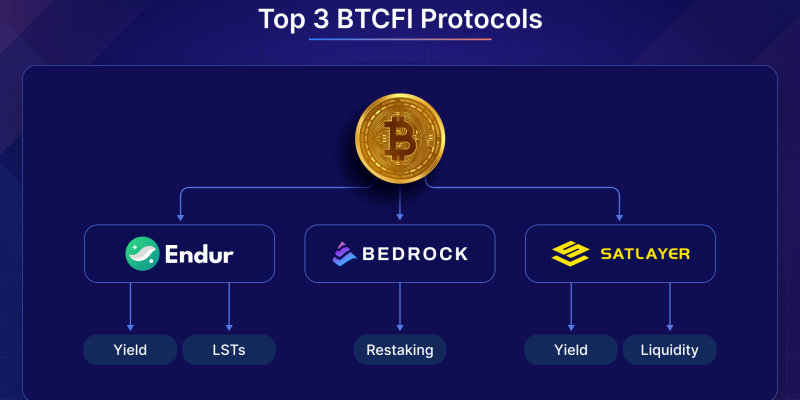
Bitcoin is increasingly held by Governments, the public, and Private companies. Yet for most of its history, BTC has remained economically idle. While this conservatism helped preserve Bitcoin’s role as a store of value, it also left a large amount of capital underutilized.
BTCFi, Bitcoin-native decentralized finance, has emerged to address this gap.
Instead of forcing BTC into speculative or custodial structures, BTCFi protocols focus on making Bitcoin productive while respecting its security and custody principles.
This article highlights three BTCFi protocols that are shaping how Bitcoin is deployed in decentralized finance today, each representing a different approach to productive BTC.
What Defines a BTCFi Protocol?
Not every protocol that accepts BTC qualifies as BTCFi. A credible BTCFi protocol typically offers:
- Deployment on Bitcoin-aligned infrastructure, whether built on specialized Layer-1 or Layer-2 execution environments that extend Bitcoin’s utility
- Bitcoin-aligned security assumptions that avoid excessive custodial trust or opaque bridging models
- Trust-minimized BTC representations, such as liquid staking tokens or secure wrapped assets
- Clear yield sources driven by lending, staking participation, or protocol incentives
- Composable design that integrates with broader DeFi systems
- Risk profiles suitable for long-term BTC holders
With that in mind, let’s look at three protocols that stand out.
1. Endur — Liquid Staking and Capital Coordination for BTCFi
Endur approaches BTCFi through liquid staking, enabling Bitcoin-backed assets to participate in network security while remaining fully composable across decentralized finance.
Instead of immobilizing BTC in a staking contract, Endur issues liquid staking tokens (LSTs) that represent staked Bitcoin positions.
These LSTs accumulate base yield derived from protocol participation and can simultaneously circulate across lending markets, automated vaults, and liquidity pools.
The yield structure is layered:
- Base Yield: Generated through staking-aligned incentives tied to network participation
- Secondary Yield: Earned when LSTs are deployed into lending protocols or liquidity strategies
- Compounded Yield: Enabled by low-cost execution environments that support frequent rebalancing
Recent ecosystem data indicates that Endur has facilitated staking volumes across both STRK and BTC assets, contributing to liquidity growth in downstream DeFi markets.
Liquidity depth is supported by integrations with lending markets and automated vault frameworks, allowing LSTs to function as productive collateral rather than passive wrappers.
From a technical standpoint, Endur acts less like a standalone yield product and more like a capital coordination layer, routing Bitcoin liquidity into different execution environments without breaking custody assumptions.
2. Bedrock — Restaking Infrastructure and Multi-Layer BTC Yield
Bedrock introduces a different approach to BTCFi by focusing on restaking mechanics that allow Bitcoin-backed assets to secure multiple layers of infrastructure simultaneously.
Rather than relying solely on base staking rewards, Bedrock’s architecture enables BTC-linked collateral to be reused across validator sets, middleware services, or yield-bearing frameworks.
This creates an additional yield layer derived from infrastructure participation rather than trading activity.
Key technical characteristics include:
- Modular restaking design allowing BTC derivatives to secure multiple networks
- Liquidity tokens that represent restaked positions
- Integration pathways with lending and vault ecosystems to extend yield surfaces
TVL metrics across Bedrock’s supported assets have grown alongside demand for restaking primitives, reflecting increasing institutional interest in security-driven yield rather than purely speculative strategies.
Yield generation within Bedrock generally comes from:
- Validation or middleware rewards tied to restaked capital
- Incentive programs designed to bootstrap security participation
- Secondary DeFi usage when restaked tokens are deployed into liquidity strategies
This architecture positions Bedrock at the intersection of Bitcoin security and cross-chain capital efficiency, allowing BTCFi participants to stack yield sources without requiring leverage.
3. Satlayer — Modular Bitcoin Security and Yield Infrastructure
Satlayer represents a more infrastructure-focused vision of BTCFi, emphasizing modular security layers built around Bitcoin-aligned staking models.
Instead of optimizing for composability first, Satlayer focuses on enabling Bitcoin to serve as a foundational security asset for decentralized services.
BTC-backed collateral can be bonded into specialized layers that provide security guarantees for applications, middleware, or decentralized networks.
Yield generation in Satlayer tends to originate from:
- Security participation rewards tied to bonded BTC assets
- Incentivized network operations
- Protocol-level emissions designed to bootstrap adoption
While liquidity reuse may initially be more constrained compared to liquid staking models, Satlayer’s design aligns closely with institutional preferences for conservative BTC deployment.
The architecture minimizes reliance on complex DeFi routing and instead focuses on building Bitcoin-backed security primitives that can later integrate into broader ecosystems.
As liquidity grows, Satlayer’s bonded assets can become building blocks for lending markets or structured yield strategies, expanding the BTCFi stack from a security-first foundation.
Why These Architectures Matter
Together, these protocols illustrate how BTCFi is evolving beyond single-use products.
- Endur demonstrates how liquid staking transforms BTC into composable capital.
- Bedrock expands yield surfaces through restaking and infrastructure participation.
- Satlayer explores Bitcoin’s role as a modular security layer for decentralized systems.
Rather than competing directly, these architectures represent complementary pathways for productive Bitcoin, enabling users to choose between composability, restaking efficiency, or security-driven yield depending on their risk tolerance and liquidity needs.
Choosing the Right BTCFi Protocol
There is no single “best” BTCFi protocol. The right choice depends on:
Yield Stability vs Yield Complexity
Some BTCFi protocols prioritize predictable base rewards tied to staking or security participation, while others introduce layered incentives through restaking, liquidity provisioning, or vault automation
Liquid staking models tend to offer more stable baseline yield derived from protocol participation, whereas restaking and liquidity-focused systems may introduce variable returns influenced by market activity, incentive emissions, or utilization rates.
For users seeking conservative exposure, stable base yield often takes precedence over higher but fluctuating incentive-driven returns.
Liquidity Requirements and Capital Mobility
Liquidity design varies significantly across BTCFi protocols.
Liquid staking frameworks typically allow BTC-backed tokens to circulate freely across lending markets and vault strategies, enabling capital to remain active even while staked.
By contrast, security-focused restaking layers may temporarily bond assets into infrastructure roles, reducing immediate liquidity but increasing participation in network validation or security incentives.
Understanding whether BTC exposure needs to remain instantly transferable, or can be bonded for longer durations, is a key consideration when selecting a protocol.
Risk Model and Security Assumptions
BTCFi risk profiles depend heavily on underlying architecture.
- Liquid staking introduces smart contract and liquidity-layer risk, balanced by composability.
- Restaking layers introduce validator or middleware risk tied to security participation.
- Liquidity provisioning exposes users to market dynamics such as impermanent loss or utilization shifts.
Institutional participants often evaluate how closely a protocol aligns with Bitcoin’s trust model, including custody design, redemption mechanisms, and transparency of reserve backing.
Long-Term Allocation vs Active Capital Deployment
BTCFi strategies can broadly be divided between long-duration positioning and active capital management.
Long-term holders may prefer protocols that allow BTC to earn base yield while remaining largely passive, minimizing operational overhead.
Active participants, however, may rotate BTC-backed assets across lending markets, liquidity pools, or vault strategies to optimize returns as market conditions evolve.
Composable ecosystems increasingly allow these approaches to coexist, enabling users to begin with conservative liquid staking and gradually expand into more active strategies without exiting BTC exposure.
Why Bitcoin Needs BTCFi Infrastructure
BTCFi is still early, but its emergence reflects a structural shift in how Bitcoin capital is being used across the broader digital asset economy.
For most of its history, Bitcoin operated primarily as a settlement layer and long-term store of value. While this conservatism strengthened Bitcoin’s credibility, it also left a significant portion of global crypto liquidity economically idle.
BTCFi infrastructure introduces execution environments where Bitcoin-backed assets can participate in lending, liquidity provisioning, and staking-aligned security models without altering Bitcoin’s base layer.
Instead of replacing Bitcoin’s role, these systems extend its utility through composable layers that preserve custody transparency and minimize trust assumptions.
From a capital markets perspective, this evolution addresses several long-standing constraints:
- Idle capital inefficiency – Large BTC reserves historically generated no on-chain yield despite increasing institutional adoption.
- Liquidity fragmentation – Without specialized execution layers, BTC-backed assets struggled to move efficiently across DeFi protocols.
- Security alignment – New models such as liquid staking and restaking allow Bitcoin liquidity to contribute to network security while remaining economically active.
As execution layers mature, BTCFi infrastructure is increasingly acting as a coordination layer for capital rather than a replacement for Bitcoin itself.
Liquid staking protocols, restaking frameworks, and BTC-native liquidity systems together form a stack where Bitcoin can secure networks, deepen liquidity markets, and generate sustainable yield without forcing users into high-leverage strategies.
Protocols that respect Bitcoin’s long-term nature, emphasizing transparency, composability, and conservative risk design, are likely to define the next phase of decentralized finance.
FAQs
- What is a BTCFi protocol?
A BTCFi protocol enables Bitcoin to earn yield or be used productively in DeFi while maintaining Bitcoin-aligned security and custody assumptions.
- Is BTCFi only for advanced users?
No. Many BTCFi protocols focus on conservative strategies such as lending or liquid staking, which are accessible to long-term holders.
- Do BTCFi protocols require leverage?
Not necessarily. Many BTCFi strategies are unleveraged and designed for stability rather than yield maximization.
- Can institutions use BTCFi protocols?
Yes, provided the protocol supports auditability, predictable liquidity, and compatible custody workflows.
- Is BTCFi replacing Bitcoin’s base layer?
No. BTCFi extends Bitcoin’s utility through execution layers and protocols, while Bitcoin remains the settlement and value anchor.












Comments