
 By
By 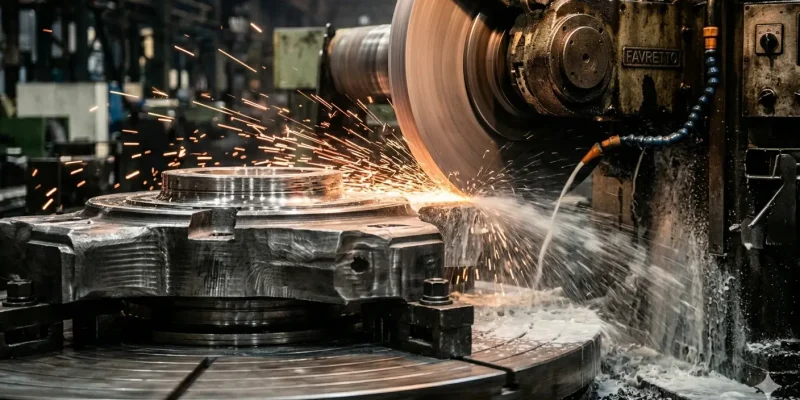
Introduction
Modern manufacturing processes require organizations to achieve both precise results and smooth surface finishes. The rotary grinding machine stands as the most effective machine for achieving this objective. The machine serves various industrial applications because it delivers accurate performance and efficient operation while processing substantial material quantities.
The complete guide explains rotary grinding machine operation through practical demonstration, which includes its components, operational process, and advantages.
What is a Rotary Grinding Machine?
A rotary grinding machine is a type of surface grinding machine that uses a rotating table to hold and move the workpiece under a grinding wheel. Unlike conventional surface grinders that move back and forth, this machine rotates the workpiece continuously, ensuring uniform material removal.
It is mainly used for:
- Flat surface finishing
- High-precision grinding
- Mass production of components
Main Components of a Rotary Grinding Machine
To understand how it works, let’s first look at its key parts:
1. Rotary Table
The circular platform serves as the area where workpieces need to be positioned. The platform maintains constant rotation during grinding operations to achieve uniform grinding wheel contact.
2. Grinding Wheel
The grinding wheel functions as the primary cutting instrument. The machine operates at high rotational speed to extract material from the workpiece surface.
3. Spindle
The spindle holds and drives the grinding wheel. It ensures smooth and stable rotation for precise grinding.
4. Base and Column
These provide structural support to the machine and keep all components aligned.
5. Coolant System
During the process of grinding, heat is generated for the coolant to decrease temperature, avoid wear and heat marks, and improve the finishing of the surface.
How Does a Rotary Grinding Machine Work?
Now, let’s break down the working process step by step:
Step 1: Loading the Workpiece
First, take the workpiece and put it on the round table of the machine. The worker needs to secure the object because it must remain stationary during operational activities. The procedure assists in achieving precise and uninterrupted operation.
Step 2: Table Rotation Begins
The machine requires activation through the power switch. The round table begins to operate in its circular motion at a gradual speed. The workpiece experiences grinding wheel contact because the machine processes all workpiece sides.
Step 3: Grinding Wheel Activation
The grinding wheel initiates its fast spinning process at the same moment. The wheel maintains its position above the workpiece without making contact during its initial operation stage.
Step 4: Controlled Material Removal
The operator needs to wait several seconds before starting to lower the grinding wheel toward the workpiece. The contact occurs as a gentle touch because the object reaches the surface without making an abrupt impact.
Step 5: Cooling and Finishing
During grinding, coolant is applied to:
- Reduce heat
- Improve tool life
- Prevent surface damage
After grinding is complete, the machine stops, and the finished component is removed.
Types of Rotary Grinding Machines
Rotary grinding machines are available in different configurations based on application needs:
Vertical Spindle Rotary Grinder
- Grinding wheel is mounted vertically
- Suitable for heavy material removal
- Common in large-scale industries
Horizontal Spindle Rotary Grinder
- Grinding wheel is mounted horizontally
- Ideal for precision surface finishing
- Used for smoother finishes
Applications of Rotary Grinding Machines
Rotary grinding machines are widely used across industries due to their versatility:
- Automotive Industry – Engine components, brake parts
- Aerospace Industry – High-precision components
- Metal Fabrication – Flat surface finishing
- Tool and Die Making – Accurate shaping and finishing
- Heavy Engineering – Large and thick components
Advantages of Rotary Grinding Machines
Here are some key benefits that make these machines highly valuable:
1. High Productivity
Continuous rotation allows faster processing compared to reciprocating grinders.
2. Uniform Surface Finish
Consistent rotation ensures even material removal across the surface.
3. Better Accuracy
Ideal for achieving tight tolerances and precision.
4. Suitable for Mass Production
Perfect for industries requiring large quantities of identical components.
5. Reduced Operator Effort
Automated operations reduce manual work and increase efficiency.
Limitations to Consider
While rotary grinding machines offer many benefits, there are a few limitations:
- Higher initial investment cost
- Requires skilled setup and operation
- Not suitable for very complex shapes
Tips for Efficient Rotary Grinding
To get the best performance from a rotary grinding machine, follow these tips:
- Use the correct grinding wheel for the material
- Maintain proper coolant flow
- Regularly check machine alignment
- Avoid excessive pressure during grinding
- Perform routine maintenance
Conclusion
The rotary grinding machine is an efficient and powerful tool. It helps users achieve precise dimensions and high-quality surface finishes. The system ensures uniform material removal and boosts productivity. This is achieved through its workpiece rotation mechanism, which operates under a high-speed grinding wheel.
Knowledge of machine operation lets you choose processes that enhance your production capacity. This applies to the automotive, aerospace, and general manufacturing industries.
A rotary grinding machine provides consistent and accurate industrial performance across various applications when users operate the machine properly and maintain it correctly.










Comments